Stanford Institute for Human-Centered Artificial Intelligence

Letter from the Denning Co-Directors
Artificial Intelligence will change lives in profound ways. We feel a collective responsibility to help guide this technology in a positive direction. To this end, in 2019 we founded the Stanford Institute for Human-Centered Artificial Intelligence (HAI) to advance AI research, education, policy, and practice to improve the human condition. We want to thank the many faculty and advisors who joined us in conceiving and creating the institute and helping to define its charter and scope.
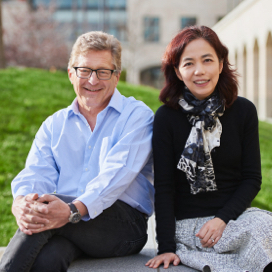
Denning Co-Directors of the
Stanford Institute for Human-Centered AI
Our growing community of researchers, scholars, fellows, students, and partners brings true diversity of thought to the critical question of how AI will affect our society. This is by nature multidisciplinary work that could not be undertaken without collaboration across many different academic departments, educational institutions, and civil society, government, and industry organizations.
As 2020 unfolded the world faced unprecedented challenges and disruption. At HAI we scarcely missed a beat, embracing each new challenge with flexibility and resolve. In many ways the online format proved liberating, allowing more rapid planning and execution of a wide range of workshops and events.
We are sincerely grateful for the support of faculty from all seven schools at Stanford as well as our extended community, our generous donors, advisors, and corporate members, and the dedicated HAI staff. As we look to the future, HAI will continue to build on Stanford’s strong culture of innovative research and long tradition of leadership in AI. Together with our ability to convene stakeholders from all sectors, we will continue to work toward a shared vision of AI that truly improves the human condition.
Exploring the full scope, scale, and impact of AI feels more urgent than ever in AY21. We look forward to continuing to work with you this year.


HAI by the Numbers

Stanford Digital Economy Lab
Professor Erik Brynjolfsson joined Stanford in July 2020 to create the new Digital Economy Lab. Brynjolfsson is a widely cited thought-leader on the effects of information technologies on the economy and business. His new lab brings together researchers and experts to examine the economic implications of AI and other digital technologies—including employment, wages, business organization, productivity, and income inequality.
The lab’s research generates insights that can help companies, policymakers, researchers, and workers rise to the challenges created by an era of profound digitization. Current research themes include AI and the future of work, measuring the digital economy, and the economic impacts of COVID-19. The activities of the lab include research funding, seminars, lab meetings with postdocs and graduate students, and interactions with executives, policymakers and sponsors.
In June, Professor Brynjolfsson presented at the HAI COVD + AI the Road Ahead conference on "How COVID has Accelerated Automation in the Workplace." During his 25 years with the Massachusetts Institute of Technology, he published nine books, including The Second Machine Age, and wrote more than 100 academic articles.